Monday, May 10, 2021

The Labour Party should support Scottish independence

After a bruising week the Labour Party is due to do some soul searching. One of the questions it should consider is whether to continue as a unionist party on the issue of Scottish independence.


  • Independence is the right way forward for Scotland. Countries like Nigeria, India, even the United States have all prospered after leaving the British Empire. None of them want to rejoin.

  • The Labour Party stands for modern progressive democratic values. Scotland wants to be independent to pursue our modern progressive democratic values. Even inside the straightjacket of union the Scottish government has introduced free prescriptions, free university education and the Scottish Child Payment. Why would Labour want to be an obstacle to more such policies?

  • It's clearly better democracy to have the country of Scotland represented internationally by a Scottish leader of a Scottish government. Local concerns can be better raised in a polity of 5 million people instead of lost among the concerns of 65 million.

  • I'll give a specific example of where the UK government has thrown Scottish interests under the bus. Whisky. Trump imposed a 25% tariff on single malt Scotch whisky which cost the industry millions. No one was there to stand up for Scotland when this trade war broke out. In fact, given a range of options it's possible that the UK negotiating team felt Scotch whisky was the best option because "Scotland's half out anyway." Then Brexit happened. Whisky exports to the EU went from £100m in Jan 2020 to £34m in Jan 2021. Another trade deal negotiated where the UK did nothing to protect our interests.

  • There will be a place for Labour in an independent Scotland. A new Scotland-specific party could in fact do rather well once the SNP is no longer carried by the independence question but rises or falls on the quality of its government. Historically Labour has done very well here.

  • Independence is not about punishing the rest of the UK. It's about building an amazing country that will be an example to the world, including offering hope and an excellent example to the rest of the UK. In time things will be better in places like Hartlepool if Scotland becomes independent, prospers, and shows people that there's an achievable progressive and fair society that can be attained just by voting for it. We will be your prosperous successful cousins next door who will show ordinary British people that there's no need to settle for two lost decades.

  • a sizeable chunk of the Labour party quietly supports independence or at least believes that Scotland should be allowed to choose.

  • it's an awful look to be siding so closely with the Tories, you encouraged Labour voters to vote Tory to block the SNP and you may never get them back. It looks like policies imposed by London on Scottish Labour politicians who cringe at having to defend them.

  • the solution Labour proposes from time to time of some sort of enhanced devolution or federalism is a solution no one asked for, no one wants and shows a top down out of touch managerialism which is something we've seen in Labour before and which voters across Britain really dislike. If you really want to annoy voters then mansplaining your wonkish ivory tower technocracies is the way to do it. Don't tell us, listen to us.

  • it's easy for people in Scotland to feel that some people in Labour in England want to keep us trapped here because we give you 50 seats that won't vote Tory. That's electoral colonialism and is a shameful reason to deny people self-determination.

  • while we're still in the Union friendship with the SNP is of enormous tactical advantage to Labour. In 2019 Jeremy Corbyn ruled out working with the SNP to form a government. Had he agreed to then he would have only needed 278 seats for Labour + SNP to form a coalition government. The bar in 2024 is raised by nearly 50 seats for Labour to win. You do want to win, right? Bringing the SNP on side is your best chance to do that and that means embracing at least our right to self-determine but better supporting our efforts to create an amazing friendly neighbouring country that will be your best achievement in government. Remember Atlee, the PM who created the NHS, considered Indian Independence his 'finest achievement'.


    (Source: https://www.outlookindia.com/website/story/the-british-pm-who-oversaw-indias-independence/295156)


Saturday, May 8, 2021

Poem: swift

 RSPB Scotland asked for something inspired by swifts:


Swift, you give our spirits a lift, you're such a gift, I love the nifty way you bank and then drift, we stare all at your aerial thrift, adrift on wind currents, soaring as they shift, you're wonderful dear darling swift.


Bit silly I know, but it's good to support these things. Here's the twitter link. https://twitter.com/CallduronVorn/status/1390961225639636993

Wednesday, May 5, 2021

Caster of Magic for Windows, turn one

 With the new patch for the classic 1994 Master of Magic we may be seeing some new players so here's a plan of how to do your first turn.

This plan depends on having at least one book in Nature Magic. (If you don't take that you'll need to explore with units).

One book in Nature Magic let's us use one of two powerful map reveals which makes the early landgrab much easier.

Here's our start:


We're going to get a map reveal on turn 2 but until then we have to clear the fog of war by moving our units out. There are no random monsters at this stage so we're fine leaving the capital unguarded.

 Here's it with our units moved.


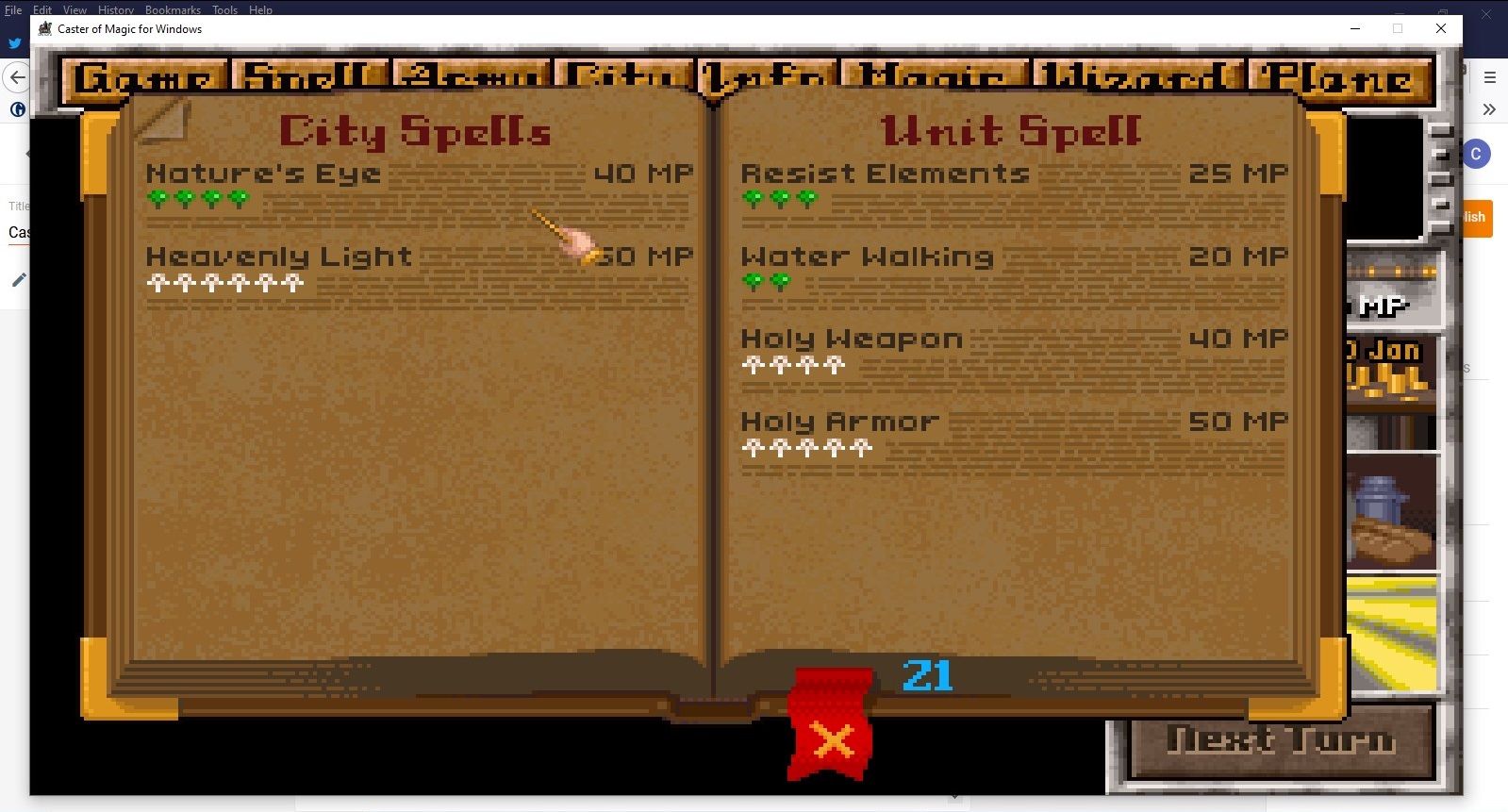
Next we'll cast one of our map reveal spells. I'm casting Nature's Eye but Earth Lore is also fine.


We don't have enough mana so we'll change how much mana we produce to maximum current mana income abandoning research and spell skill for now. We'll also alchemise most of our gold into power.


That gives a fair amount of mana for this start which is very useful for this build allowing us to cast several spells. As soon as you don't need to cast something you can balance out your mana income later in the game.

Finally we'll do our building. I'm choosing Marketplace into Granary. I don't have Sawmill available otherwise that might be my first pick.


And on turn 2 here's what the map looks like after the reveal.


The highlighting of areas that can be settled is a new feature and quite useful. (It's showing a band at top right and a desert square in the south west).


Hope that helps, enjoy this classic game if you're coming back or just starting it.

Tuesday, May 4, 2021

HSW: poem. Wall

 High Street Writers (HSW) is a local writers' group where we write to prompts. The prompt for this one was wall. Here's my effort:


Wall by SJ

Wall.

Build your wall,
build it tall.
Your country's pedestal.
Gloat when it appalls us, galls us
That you festoon it with cages
Filled with kids of all ages
While the decent world rages.

Your wall will fall.

We'll watch you bawl
When we end it all.
Your vulgarity, barbarity, and open criminality
Will  never beat humanity.

Your  wall will fall.

Tuesday, April 6, 2021

MTGA: Lessons and Learn spells in Strixhaven.

 A new mechanic in the forthcoming new Magic set is the Learn/Lesson mechanic. Some cards have the keyword Learn which allows you to fetch a Lesson card from your sideboard. If you want you can rummage instead but generally you'll only do that if you're out of Lesson cards.

In Limited this means you need to have both some sources of Learn in your deck and a reasonable collection of Lesson cards to fetch.


Regarding Lessons there are three scenarios:

- you have really good stuff to fetch. Learn cards are a more valuable pick.

- you have stuff to pick that makes the combined value of the Learn card plus the Lesson card above baseline C grade, 20th-23rd pick cards.

- you didn't really get there. You have Learn cards without Lessons or your cards are weak or situational.


Lesson

So here's the list of Lesson cards. There are 20 Lesson cards. All Lessons are Sorceries.

There is one mythic, Mascot Expedition (above), which is a strong 7 mana finisher. It's strong enough to consider main-decking but fetching it for free off a Lesson is a more attractive option. It's colourless.

There are 5 rares, one in each colour. The black and white ones are situational but the other three are well worth a card. So casting any Learn spell then getting one of the red, green or blue rare lessons is a fine play.

There are 5 uncommons, one in each colour. They are all situational but potentially quite powerful. They remove something usually in return for giving some minor advantage.

There are 9 commons. 5 are dual colour but where you can use either colour to cast. 4 are colourless. They range from clearly not being worth a card to worth a replacement level main deck card (eg a 4/4 creature for 5 mana).

So in deckbuilding you'll need a concept of "Lesson strength." Just how impactful is it when you play a Learn card (based on your pool of Lessons)? If you have an adequate C- grade card as a lesson plus a couple of situational but more powerful cards then Learn cards are ok, that's probably the starting point. If you have a better Lesson pool then you can run worse Learn cards as the Lesson half of the combo is so powerful.

If you do decide to collect Learn and Lesson cards you will probably need more Learn cards than Lesson cards. This is because if you draw 20 cards from a 40 card deck (a 13ish turn game) you will only see half of your Learn cards while having access to all your Lesson cards. The value of Learn goes down each time you use it as, presumably, you will take your best Lesson card leaving the remnants.

 Good fixing allows a wider variety of Lesson cards to be viable.

It seems clear that we will have some quite good cards to find if we draft for them or get lucky in our Sealed pools. So let's now look at the Learn cards.


Learn

Here is the list of the 21 Learn cards. They are a wide variety of spell types.

No mythics.

There are 5 rares, one in each colour. Each is solidly worth a card even if you have no Lessons to fetch.


There are 6 uncommons. Divide by zero, Igneous Inspiration, and Professor of Symbology are just about worth a card even if you didn't have any lessons to fetch. The other three are useful effects when they also draw a worthwhile Lesson card.

There are 10 commons with 2 blue, 3 black, 2 green, 2 red, 3 white. (That's more than 10 total because some have either/or dual mana costs). Generally they're not cards you would usually include in the deck if they didn't draw you a lesson. The exception is Rise of Extus which would make most black or white decks as 6 mana unconditional removal. Some are fairly bad so a card like Guiding Voice is only worth it if you really need Learn.


Conclusion

In general Learn/Lesson cards are a little below the power level of a typical card - the mechanic depends on the usefulness of drawing the Lesson card to create a situation where the two cards combined are more impactful than other options.

 Learn/Lesson is tempo negative as you have to find the mana to cast two spells, the second being a Sorcery.

There's a real risk of not drawing your Learn cards leaving all your Lessons sidelined. Obviously you can reduce the risk by picking more Learn cards to play or to draft but that risks going down in card quality and/or hitting a point where you've fetched your Lessons and your Learn cards are just mediocre cards with nothing more to fetch.

With Sealed check which Lessons you have then look at your Learn cards. Did you luck into a viable Learn/Lesson strategy?

Draft is much more interesting. You need to decide whether there's a Learn/Lesson subtheme to your deck and draft to support it. It's an element that you should try to keep open to. Eg if there's nothing you particularly want to play take the mediocre Learn card in case you draw a great lesson later in the draft.

Let's consider a difficult decision. Pack 1 pick 1 you have a decent rare Lesson and a really strong Uncommon. Do you take the Lesson? In truth the question can only be answered after format experience but I'm thinking yes, you would take the Lesson. With 21 Learn cards in the format it's reasonable to expect you'll find decent Learn spells as you navigate through the draft. So long as you think a mediocre Learn spell plus your good Lesson rare outpowers the strong Uncommon then it's probably correct to risk it. Another consideration is that you may not draw your Uncommon - it's one card in 40 - but if you end up with 4 Learn cards then any of those will either draw your rare Lesson or will fetch a situationally even better Lesson.

There will be some very difficult, and perhaps risky choices where you have to decide between a card that will be fine if the Learn/Lesson element comes together but which will cost you a decent playable if it doesn't.

In Kaldheim the snow mechanic meant that we often collected cards outside the usual 23 non-land cards we assemble for a limited deck. The Learn/Lesson mechanic is more of the same - we need both a 23 card deck and some Lessons in the sideboard if we're building this type of deck. In Kaldheim (inspired by a Luis Scott-Vargas draft video early in the format) people began to much more aggressively draft snow covered lands. We may see a similar effect in this format with people aggressively drafting Learn/Lesson in pack 1 to make sure that they can operate this mechanic effectively.

Overall it's a fine mechanic that will see many of us deep in thought in the weeks to come.


Happy drafting everyone!

Afterword: I initially made some mistakes which should now be fixed. Thanks to /u/nepetalast and /u/itsdrewmiller from the LR Cast subreddit and to Scrappykid from the Lords of Limited discord.

Tuesday, February 2, 2021

So disabled people? What do you want?

 - World peace. I'd like to see humanity move past war as a means of settling arguments through the creation of or perhaps the adaptation of the UN into a body that mediates international disputes making countries find a peaceful solution using persuasion, censure, cultural and economic sanctions supported by a world of nations working in concert.

- Reversing climate change.

- Curing pain. I'd like to see medicine advance so that no one should have to live in pain or with reduced capacity.

- Ending poverty. There's more than enough for everyone. No, Tarquin, you can't run your private jet while kids down the road are going without food.

- Build communities based on love. Friendship, tolerance, humour, compassion and romance. That's what we all should feel when we think of the place we live.

- Colonise space. Solve the FTL problem and find secure exciting frontier settlements for the adventurous to build new lives.


"Hold on," you say, "how can we possibly give you all that?"

Oh you misunderstand. We're not asking for you to give us all that. We're asking you to stop getting in our way while we work on giving you all that.


You're welcome.

Friday, January 29, 2021

DWP: Work Capability Assessments (WCAs)

 I want to explain how this important cog in our social security works.

It's completely kafkaesque.


You go in for a work capability assessment. You're met by a person working for an outsourced company who has a relevant health degree but who is not a doctor. When I did mine I was interviewed by a young woman, very charming, very anxious. They're keen to assure you that no decision will be taken today, it's just the collection of information for the computer system. And it was, bless her, she's just a young woman at the start of her career making a living by collecting information on behalf of the government.

You're sat down and they ask you to do various tasks like raising your arm above your shoulder. Irrespective of what's your medical issue is. Most people - most disabled people - score 0/15 on this test. "Customers" invariably tell the interviewer about their disability and she'll listen politely then record the results of the test. None of what we say gets passed up the chain.

"I get chronic anxiety attacks and haven't slept for three weeks."

"Oh, I'm so sorry to hear that. Can you touch your toes?"

The data is typed into a computer where it's reviewed by what they call a "Decision Maker." I don't even know if this is a human being. They almost invariably find you fit for work. Partly because of the testing but I think they sometimes cheat. They've found blind people fit for work based on the WCA. They've found dead people fit for work based on the WCA.

The "decision maker" is based in an office a long way from the claimant. Deliberately. There's an office in London that does this work but if you claim in London you won't deal with that office. It'll be handled a long way away. It used to be Makersfield, when I last claimed money it was Northern Ireland. We're governed remotely as if we were in a colony.


Then you have to go on to JSA/UC or sign off. On UC you are in the jobseeking kind of UC so they make you apply vigorously to a large quota of jobs.

This leads to a humiliating period of turning up for job interviews for jobs you obviously can't do. "Why have you applied for a job in our warehouse when you're in a wheelchair?" might be what the interviewer wants to say but can't because it could be deemed discriminatory. Instead this horrible potemkin interview happens where they interview you as if you were a real candidate while you pretend to be interested as if you were going to cart boxes around while on crutches. Then a few days later you get a polite rejection letter.

Slow polite crushing of the human spirit.


You can appeal against the "Decision" and the appeals usually succeed because as soon as the facts are reviewed by an impartial human being he/she spots that the person clearly isn't fit for work. Most of us don't appeal though and just kinda get run over by the system. Appeals are fraught and stressful, rather like a court case. There's no formal help, you have to use things like CAB.

National equity tracker funds: a community wealth building idea

 Have you ever had a pot of money and thought I'd like to put that aside for the future? Let's imagine you do have, have a think abo...